

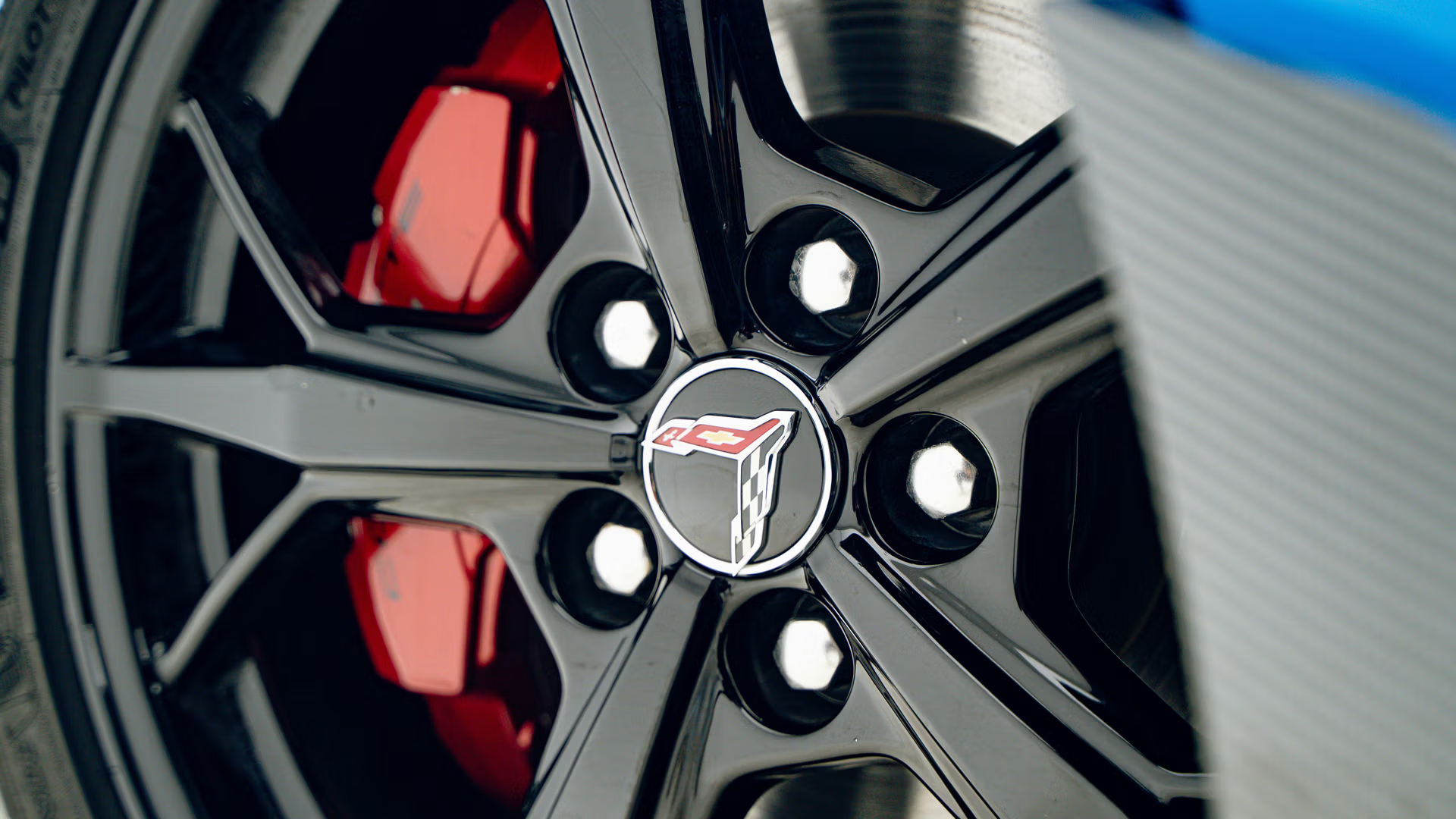
The future of CGI in Car Commercials is no longer speculative—it is actively reshaping how automotive brands design, present, and sell vehicles. At Night Wolves Studio, we see Automotive Advertising transitioning from production-heavy execution to precision-driven digital craftsmanship, where CGI is not just a tool, but the core medium of storytelling, validation, and scale.
What follows isn’t a trend list—it’s a directional shift in how automotive brands will operate, communicate, and compete.
The Next Phase of Automotive CGI: What’s Actually Changing
1. Hyper-Realism Becomes the Baseline, Not the Benchmark
Photorealism in automotive CGI is no longer a differentiator—it’s an expectation.
The next evolution of CGI in Car Commercials will push beyond visual accuracy into perceptual realism—where materials, lighting, and motion behave exactly as they would in the physical world.
What this unlocks in Automotive Advertising:
- Launch campaigns before production prototypes exist
- Precision control over every visual variable (paint, reflections, weather, terrain)
- Global campaign consistency without reshoots
This is where premium automotive brands separate from generic execution.
→ Explore how this translates into production quality on our Work page.
2. Real-Time Rendering Will Redefine Production Pipelines
The shift to real-time engines is fundamentally changing how automotive video production is executed.
Instead of linear workflows, CGI in Car Commercials is moving toward dynamic, iterative environments where changes happen instantly.
Impact on Automotive Advertising:
- Live iteration during creative reviews
- Interactive campaign assets (not just static films)
- Faster go-to-market without compromising visual fidelity
Real-time CGI isn’t just about speed—it’s about creative control at scale.
3. Interactive Automotive Experiences Will Replace Passive Viewing
The future of Automotive Advertising is not just watched—it’s experienced.
With real-time CGI and web-integrated 3D, CGI in Car Commercials is expanding into:
- Interactive vehicle configurators
- Immersive digital showrooms
- Personalized ad experiences based on user behavior
This transforms audiences from viewers into participants—dramatically increasing engagement depth.
→ See how experiential CGI is being applied in our Experience page.
4. VR & AR Will Extend Automotive Storytelling Beyond Screens
Virtual and augmented reality are no longer experimental—they are becoming core layers in automotive CGI ecosystems.
Where this impacts Automotive Advertising:
- Virtual test drives for pre-launch vehicles
- AR-based product visualization in real-world environments
- Immersive brand storytelling at events and retail spaces
For high-end automotive brands, this is how digital presence translates into physical intent.
5. AI Will Reshape How CGI in Car Commercials Is Produced
Artificial Intelligence is not replacing creativity—it’s amplifying it.
In automotive CGI workflows, AI is already enabling:
- Rapid generation of multiple design and lighting variations
- Intelligent scene optimization for faster rendering
- Predictive simulation of real-world behavior
For Automotive Advertising, this means:
- More creative exploration within tighter timelines
- Higher output quality without increasing production complexity
- Data-informed visual storytelling
6. Digital Twins Will Bridge Engineering, Design, and Marketing
Digital twin technology will become a central pillar in automotive CGI pipelines.
A single, high-fidelity digital asset will serve:
- Design validation
- Engineering simulation
- Marketing and campaign production
This eliminates fragmentation between departments and ensures that CGI in Car Commercials is not just visually accurate—but technically authentic.
7. Autonomous Vehicle Visualization Will Demand New Storytelling Models
As autonomous mobility evolves, Automotive Advertising must communicate systems—not just surfaces.
CGI will be critical in visualizing:
- Sensor perception (LiDAR, radar, AI decision layers)
- Complex driving scenarios
- Safety systems and edge-case behaviors
This introduces a new layer of narrative complexity in CGI in Car Commercials—where invisible technology must be made visually intuitive.
8. Sustainability Will Be Visualized, Not Just Claimed
Sustainability messaging in Automotive Advertising will shift from verbal claims to visual proof.
With CGI, brands can demonstrate:
- Aerodynamic efficiency
- Material innovation
- Lifecycle impact
This positions automotive CGI as a strategic tool for transparency—not just aesthetics.
What This Means for Automotive Brands
The implications of these shifts are structural, not incremental:
1. Design Cycles Compress
CGI-driven workflows reduce iteration time and accelerate innovation.
2. Marketing Becomes Asset-Led, Not Shoot-Led
Physical shoots become optional—not foundational.
3. Customer Engagement Deepens
Interactive CGI experiences increase consideration and intent.
4. Brand Perception Elevates
High-end CGI execution directly influences perceived product quality.
5. Competitive Advantage Moves to Execution Quality
Not all CGI is equal—craft, detail, and control define outcomes.
The Night Wolves Perspective
At Night Wolves Studio, we don’t view CGI in Car Commercials as a replacement for traditional production—we see it as the evolution of Automotive Advertising itself.
The future belongs to brands that:
- Build with digital-first pipelines
- Invest in high-fidelity CGI ecosystems
- Treat visual storytelling as a precision discipline
This is no longer about adopting CGI.
It’s about mastering it.
Explore Further
- Learn How CGI Transforms Automobile Design and Prototyping
- Impact of CGI on Modern Automotive Ad Campaigns
People Also Ask
Q: What is the future of CGI in the automotive industry?
The future of CGI in Car Commercials and automotive design lies in real-time rendering, AI-assisted production, and immersive digital environments. CGI will power everything from digital twins to interactive Automotive Advertising experiences.
Q: How will AI impact CGI in car design?
AI enhances automotive CGI by automating complex processes, enabling faster iterations, and improving realism through predictive simulations—allowing creative teams to focus on higher-level storytelling and design innovation.
Q: Are real-time rendering engines shaping the future of automotive CGI?
Yes. Real-time engines are transforming CGI in Car Commercials by enabling instant feedback, dynamic environments, and scalable content production—making Automotive Advertising more agile and interactive than ever.