

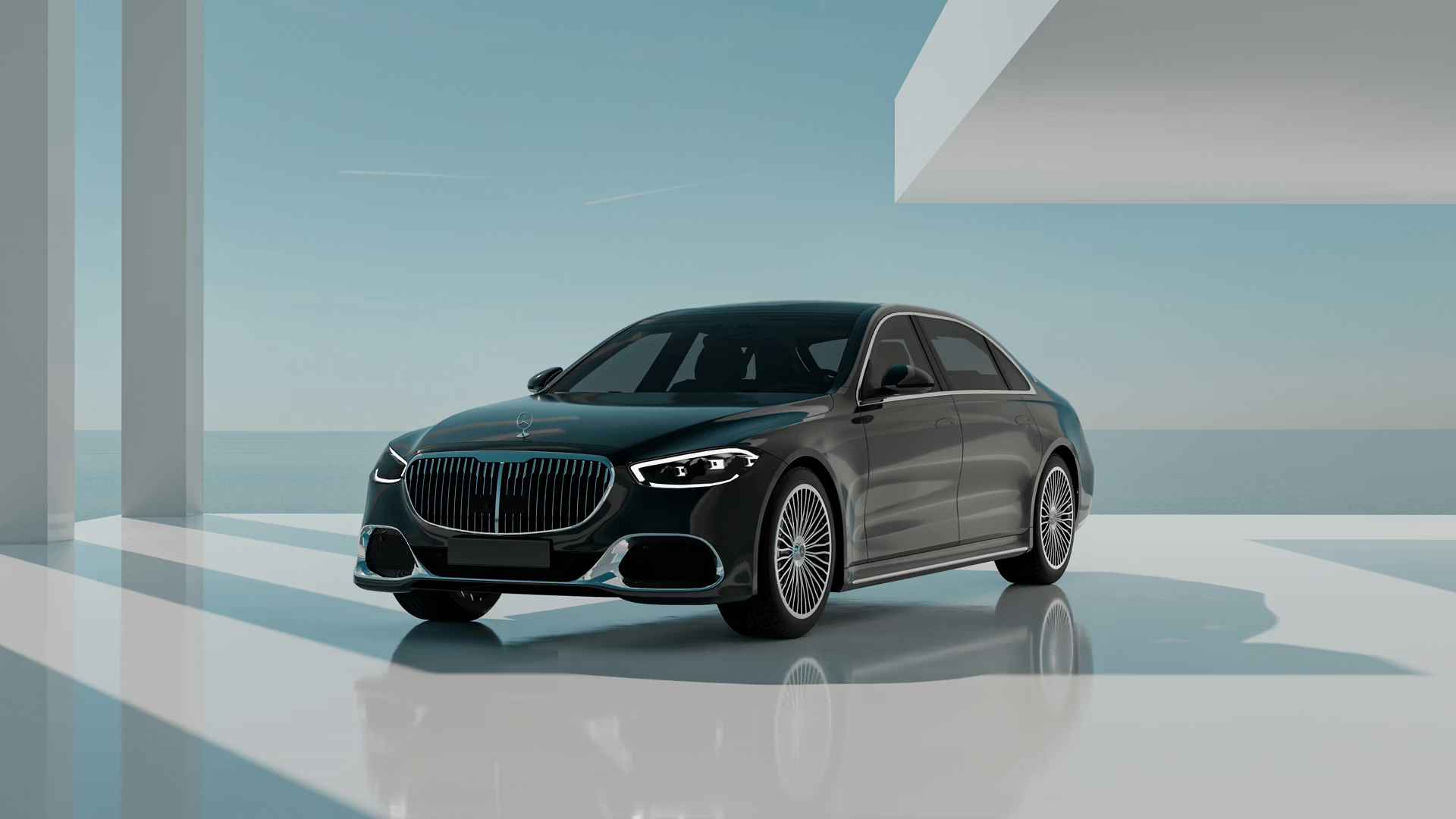
CGI in Car Commercials is no longer a supporting tool—it is the foundation of modern Automotive Advertising. At Night Wolves, we don’t treat computer-generated imagery as an enhancement to production; we build entire visual narratives around it.
What once depended on physical shoots, controlled locations, and logistical constraints is now engineered in fully digital environments—where precision, scale, and imagination operate without limitation. Today, CGI in Car Commercials enables automotive brands to present vehicles exactly as they are envisioned—perfect, controlled, and cinematic at every frame.
As an automotive video production partner, Night Wolves combines cinematic direction, CGI pipelines, and advanced virtual production workflows to create automotive campaigns designed for global launch standards.
The Evolution of CGI in Automotive Advertising
The trajectory of CGI in Automotive Advertising has shifted from experimental visualization to industry standard.
In its early phase, CGI was primarily used for concept previews and static design validation. Now, it drives full-scale commercial production pipelines—from ideation to final delivery. The advancement of real-time engines, ray tracing, and physically accurate shading models has redefined what qualifies as “real.”
At Night Wolves, we operate in a space where virtual production meets cinematic storytelling. Tools like The Mill’s Blackbird introduced hybrid workflows, but the industry has moved further—toward fully digital vehicles, environments, and camera systems that eliminate dependency on physical capture altogether.
The result: automotive visuals that are not just photoreal—but hyper-controlled, brand-perfect, and globally scalable.
For brands exploring advanced automotive CGI workflows and launch-ready visuals, explore our Renault project:
Renault CGI Project
Why CGI in Car Commercials Dominates Modern Automotive Advertising
1. Absolute Creative Control
CGI in Car Commercials removes all physical constraints. Lighting, weather, terrain, and even physics can be art-directed with precision. This enables automotive brands to present vehicles in environments that would otherwise be impossible to capture.
2. Cinematic Consistency at Scale
In Automotive Advertising, consistency across campaigns is critical. CGI pipelines allow for unified visual language across multiple films, markets, and formats—without variability.
3. Pre-Production Without Limitations
With CGI, vehicles don’t need to exist physically. Automotive brands can launch campaigns before manufacturing cycles are complete—accelerating go-to-market timelines while maintaining visual fidelity.
4. High-Precision Customization
From trims and materials to lighting scenarios and environments, CGI in Car Commercials allows infinite variations from a single master asset—enabling targeted storytelling for global markets.
5. Controlled Performance Storytelling
Speed, aerodynamics, and engineering details can be visualized with clarity that traditional filming cannot achieve. CGI allows us to design performance narratives, not just capture them.
Core CGI Techniques in Automotive Advertising
1. 3D Automotive Modeling
Every CGI car commercial begins with high-fidelity 3D models built to exact OEM specifications. This includes micro-surface detailing, material accuracy, and engineering precision.
2. Virtual Cinematography
We approach CGI like a film set—using digital cameras, lenses, and lighting rigs. This enables true cinematic direction within a fully controlled environment.
3. Real-Time Visualization
Advanced engines allow for interactive workflows, enabling faster iteration and immediate visual feedback—critical in high-end Automotive Advertising production.
4. CGI + Live Action Integration
Hybrid workflows still play a role. Seamlessly blending CGI vehicles with real-world plates creates grounded realism while maintaining creative flexibility.
Challenges in CGI Automotive Production (And How We Solve Them)
1. Maintaining Photorealism
The benchmark for CGI in Car Commercials is invisibility—audiences should not perceive the difference. This demands advanced shading, lighting accuracy, and physics simulation.
2. Technical Complexity
High-end CGI requires multidisciplinary expertise—modeling, texturing, lighting, compositing, and simulation. At Night Wolves, this is not fragmented—it’s a unified pipeline.
3. Balancing Realism with Brand Vision
Automotive brands don’t just sell cars—they sell aspiration. The challenge is not realism alone, but controlled realism that aligns with brand identity.
The Future of CGI in Automotive Advertising
The next phase of CGI in Car Commercials is already unfolding—and it’s redefining how automotive brands engage audiences.
1. Fully Virtual Production Pipelines
End-to-end digital production is becoming the default. From concept to final film, everything is built, directed, and delivered in virtual environments.
2. AI-Driven Content Personalization
AI will enable dynamic Automotive Advertising—where visuals adapt in real time based on audience behavior, geography, and preferences.
3. Immersive Brand Experiences
AR, VR, and interactive platforms will transform passive viewers into active participants—allowing users to explore vehicles in fully immersive digital worlds.
4. Sustainable Production Models
With no physical shoots, logistics, or prototypes, CGI in Car Commercials is inherently aligned with the shift toward more sustainable production ecosystems.
Explore CGI Trends
- Role of CGI in Car Design
- Future Trends in Automotive CGI
- Impact of CGI on Modern Automotive ad Campaigns
Explore more automotive CGI and automotive video production work from Night Wolves:
Night Wolves Portfolio
Conclusion
CGI in Car Commercials has fundamentally redefined Automotive Advertising. It is no longer about replicating reality—it’s about engineering it with intent. While challenges remain, the benefits of CGI in automotive advertising are clear, making it an indispensable tool for car manufacturers and advertisers alike.
At Night Wolves, we leverage CGI to create automotive films that are not constrained by the physical world—but are instead driven by vision, precision, and storytelling control.
As the industry continues to evolve, one thing is clear: the future of automotive advertising will not be shot—it will be built.
People Also Ask
1. Why is CGI used in car commercials?
Answer: CGI in Car Commercials is used to achieve complete creative control, enabling brands to showcase vehicles in controlled, cinematic, and highly stylized environments that are not feasible through traditional production.
2.What are the benefits of CGI over traditional automotive advertising production?
Answer: Automotive Advertising powered by CGI offers scalability, precision, flexibility, and the ability to visualize vehicles before production—while maintaining a consistent global brand narrative.
3. How realistic is CGI in modern automotive ads?
Answer: With advanced rendering, lighting simulation, and material accuracy, CGI in Car Commercials is now indistinguishable from real footage when executed at a high level.
4. How is CGI shaping the future of automotive marketing?
Answer: CGI in Automotive Advertising is enabling virtual showrooms, immersive brand experiences, and personalized content—transforming how consumers interact with automotive brands.
5. What are the challenges of CGI in automotive advertising?
Answer: The primary challenges include achieving photorealism, managing technical complexity, and aligning visuals with brand identity—but when executed correctly, these become competitive advantages.