

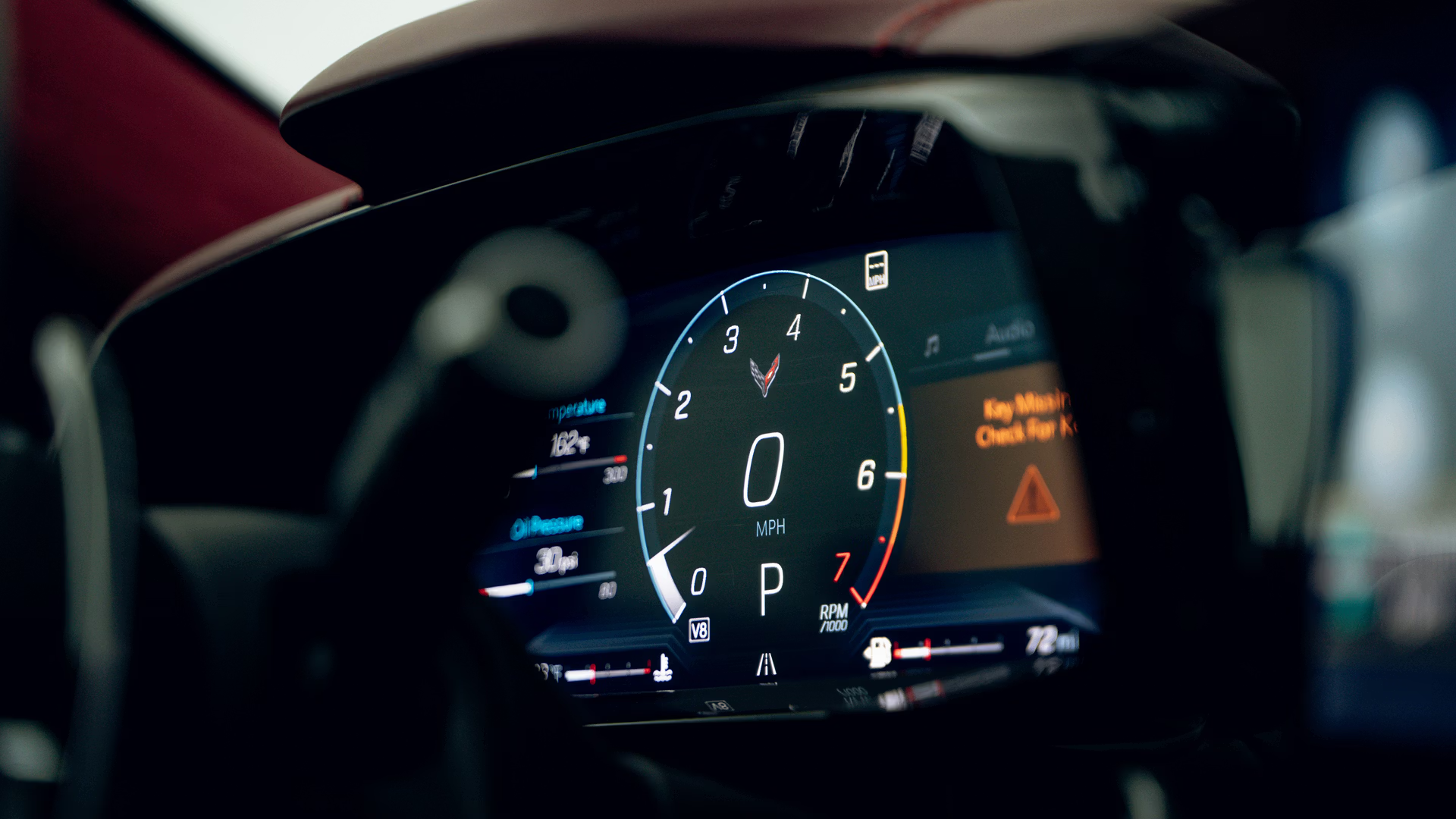
What is CGI in the Automotive Industry?
Computer-generated imagery (CGI) is the process of creating hyper-realistic visuals, environments, and motion content using advanced 3D technologies. In the automotive industry, CGI is no longer an experimental tool—it’s a core production pipeline powering design visualization, automotive advertising, and digital-first brand storytelling.
At Night Wolves, we don’t treat CGI as a substitute for production—we treat it as an unrestricted creative and engineering layer that redefines what automotive visuals can achieve.
Key Benefits of CGI for the Automobile Industry
1. Unlimited Creative Control in Automotive Advertising
CGI removes physical constraints entirely.
In traditional production, location, weather, logistics, and timing define what’s possible. With CGI in automotive advertising:
- Vehicles can exist in impossible environments—from hyper-real terrains to abstract design spaces
- Lighting, reflections, and surfaces are precision-controlled at pixel level
- Campaign visuals remain consistent across global markets
This level of control is what enables modern high-performance car commercials to feel cinematic, stylized, and globally scalable.
Read the blog on CGI in future car design
2. Scalable Visual Production Across Variants
The modern automobile lineup is complex—multiple trims, colors, finishes, and configurations.
With CGI:
- Every variant can be visualized without reshooting
- Updates in design (grilles, wheels, interiors) can be reflected instantly
- Campaigns can be localized across regions without recreating assets
This makes CGI indispensable for global automotive launches and digital configurators.
3. Photorealism That Drives Conversion
The gap between CGI and reality has effectively closed.
Advanced CGI pipelines now deliver:
- Physically accurate materials (paint, chrome, glass, carbon fiber)
- Real-world lighting simulations using HDR environments
- Cinematic motion that mirrors real camera physics
For the automotive industry, this translates into:
- Higher engagement in automotive advertising campaigns
- Stronger visual recall
- More persuasive digital-first experiences
In many cases, audiences cannot distinguish between CGI and live-action footage—and that’s the benchmark.
4. Accelerated Automotive Design and Visualization
CGI plays a critical role long before a car reaches the road.
In the design phase:
- Teams use virtual prototyping to visualize concepts in real-world conditions
- Design iterations happen in real-time without rebuilding physical models
- Stakeholders can review vehicles in multiple environments instantly
This shortens decision cycles and enhances design precision across the automotive industry.
5. Seamless Global Collaboration
Automotive production is inherently global.
CGI enables:
- Distributed teams (design, engineering, marketing) to work on centralized digital assets
- Real-time feedback loops across continents
- Faster alignment between brand, product, and campaign teams
This is especially critical for large-scale automotive brands managing multi-market launches.
6. Immersive Customer Experiences
Modern consumers don’t just want to see a car—they want to experience it.
CGI powers:
- Interactive car configurators
- Virtual showrooms and digital retail platforms
- Real-time product visualization across devices
Combined with AR/VR layers, CGI allows users to:
- Explore interiors and exteriors in detail
- Experience lighting conditions, finishes, and environments
- Engage with the vehicle before it physically exists
This is where automotive marketing shifts from storytelling to experience design.
7. Consistency Across the Entire Automotive Marketing Ecosystem
From TVCs to social media to configurators—visual consistency is critical.
With CGI:
- A single master asset pipeline feeds all marketing channels
- Campaign visuals remain consistent across film, print, digital, and OOH
- Brand identity is maintained at every touchpoint
This unified approach is what defines modern automotive advertising systems.
8. Sustainable and Future-Ready Production
The automotive industry is evolving—and so is production methodology.
CGI enables:
- Reduced dependency on physical shoots and logistics
- Minimal environmental disruption compared to traditional production
- Fully digital asset pipelines that can be reused, updated, and scaled
For forward-thinking brands, CGI is not just a creative tool—it’s part of a future-ready production infrastructure.
Why CGI is Now Core to the Automotive Industry
The shift is clear: CGI is no longer optional in automotive advertising—it’s foundational.
Brands that adopt CGI effectively gain:
- Faster go-to-market execution
- Higher visual impact
- Greater creative differentiation
- Scalable global campaigns
At Night Wolves Studio, we approach CGI as a strategic advantage, not just a visual upgrade—engineering every frame to align with performance, design intent, and brand narrative.
Conclusion
The benefits of CGI for the automobile industry extend far beyond visuals. From design acceleration to immersive customer experiences, CGI is reshaping how vehicles are imagined, built, and marketed.
As the automotive industry becomes increasingly digital, the role of CGI will only deepen—powering the next generation of automotive advertising, product visualization, and brand storytelling.
For brands aiming to lead—not follow—CGI is the medium where innovation becomes visible.