


Photography needs a finished product in a studio. 3D product rendering needs product data instead: CAD files if they exist, otherwise detailed measurements and reference images, and it can start weeks before a physical unit is ready. For UK furniture manufacturers comparing 3D product rendering vs photography UK, that difference settles more of the decision than cost or image quality, which is usually where the comparison starts.
| Product Photography | 3D Rendering | |
| Needs product to exist? | Yes | No — CAD or reference images enough |
| Best for | Single hero shot, one finish | Multiple colours, sizes, or configurations |
| Cost at 1 SKU | Usually lower | Usually higher (model build cost) |
| Cost at 6+ variants | Scales with each shoot | Usually lower (one model, swapped finishes) |
| Texture accuracy | Captures real material behaviour directly | Depends on lighting/material setup quality |
| Lead time before product exists | Not possible | Can start immediately |
When Is Product Photography the Better Choice?
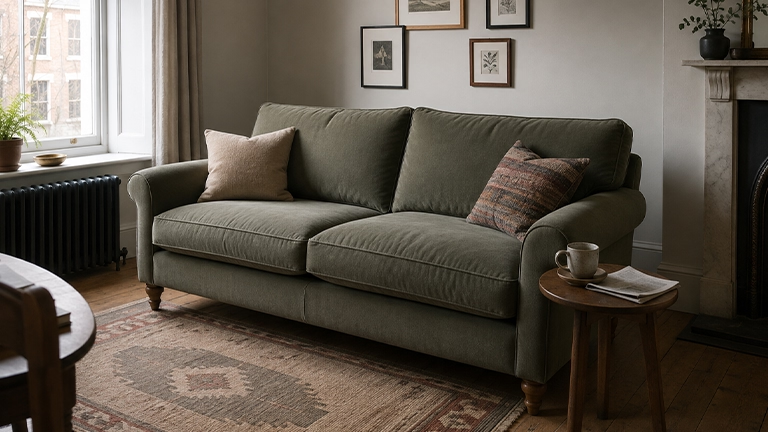
Where photography still wins, plainly: a finished product, photographed well, captures texture and material behaviour that’s genuinely hard to recreate digitally.
A leather sofa already sitting in a showroom, in one colour, needed for one hero shot, is usually simpler to photograph than to rebuild as a 3D model. The same logic applies to a single armchair launching in one finish with no planned variants.
Building a full model for one image that will never be reused is more setup than the situation calls for. Photography wins here not because it’s cheaper generally, but because rendering’s main advantage, reusing one model across many outputs, never gets used.
When Should You Choose 3D Product Rendering?
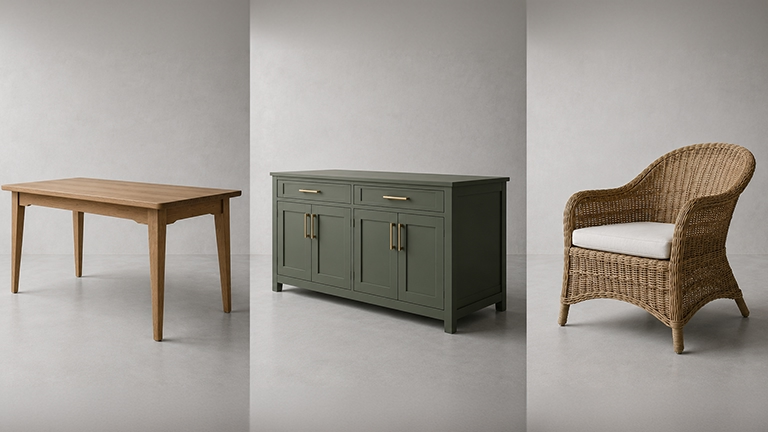
Rendering starts to make sense the moment “one image” becomes “many.” A dining table launching in three wood tones, two sizes, and an optional extension leaf isn’t six photoshoots waiting to happen. It’s one model adjusted six ways, which is usually where rendering pulls ahead on cost and turnaround.
This is where 3D product rendering services UK can be particularly useful for furniture manufacturers working from existing CAD data. The same model can be adapted for ecommerce, catalogues, product launches and marketing campaigns without rebuilding the product for every output.
The same applies outside furniture: a kitchen door front available in six finishes and three handle options is the same problem, one model built once and finished six ways, not six separate photography setups.
It’s also the only option when the product won’t physically exist for another two months and the campaign has to launch on schedule anyway. This is where product launch visualisation usually earns its cost, ahead of any campaign deadline.
How 3D Product Rendering Works
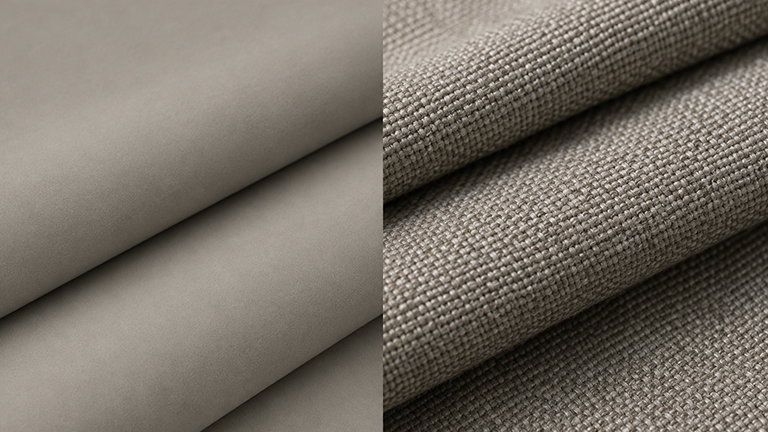
Getting a render to pass as a photograph is its own discipline. It depends on how accurately materials, lighting and camera behaviour are built into the scene: fabric that catches light the way real fabric does, a wood grain that doesn’t repeat in an obviously tiled pattern, reflections that behave the way they would on an actual showroom floor.
This is the same CAD-to-CGI workflow used across every range we render. Done well, most buyers can’t tell the difference from a photograph. Done poorly, it’s usually the lighting or material setup that gives it away, not the concept of rendering itself.
Is 3D Product Rendering Cheaper Than Photography?
Cost doesn’t split cleanly either way. A photoshoot’s price moves with studio time, day rates, and how many setups get booked. A render’s price moves with how complex the model is and how many variants get built from it.
Neither is reliably cheaper in the abstract, a single hero shot usually costs less as a photograph, a ten-variant catalogue almost always costs less as a render, and most real projects sit somewhere between those two extremes rather than at either end.
For UK furniture brands, the important comparison is therefore not simply the price of one image. It is the total production cost across the number of products, finishes, configurations, angles and marketing channels required.
Some brands don’t pick just one. Hero shots get photographed, variants and scale get rendered, and the two get used together rather than treated as a fork in the road.
3D Product Rendering or Photography for Ecommerce: Which Should You Choose?
For ecommerce teams, the question of 3D product rendering or photography for ecommerce often comes down to catalogue scale.
If a product has one finish and only needs a small number of images, photography can be the straightforward option. But when a furniture range includes multiple colours, materials, sizes or configurations, rendering provides a more scalable way to create consistent product imagery.
One approved 3D model can be used to generate different finishes, camera angles, configurations and environments without arranging a new photoshoot for every variation.
This is particularly useful when ecommerce teams need consistent imagery across large product catalogues or need new visuals quickly as products and finishes change.
3D rendering can support ecommerce with:
- Multiple product finishes.
- Different sizes and configurations.
- Multiple product angles.
- Consistent product imagery across a catalogue.
- New visuals without organising another physical photoshoot.
- Product imagery for products that are not yet physically available.
How to Decide Between 3D Product Rendering and Photography
Two questions actually decide this, more than any of the above: does the product exist yet, and how many versions of it need to appear somewhere. We usually start there before talking about anything else, since the rest of the decision mostly makes itself once those two are answered honestly. This applies whether the brand is working directly with us or through a design studio managing the relationship, and it’s the same starting point covered under Product visualisation for manufacturers.
Frequently Asked Questions
Question: Do you need our CAD files to start, or can you work without them?
CAD is the ideal starting point. We can take existing design data and develop it into production-ready visual content, keeping the final render faithful to the physical product. Where CAD doesn’t exist, detailed measurements and reference photography can work for simpler products.
Question: Can you produce renders in bulk, across a full colour or finish range?
Yes. Product rendering can be structured for volume, whether that means multiple SKUs, colourways, configurations or a full set of product angles. We establish the visual and technical standard first, then build a consistent production workflow around the full range.
Question: Can renders match our existing photography, so the two sit together on the same page?
Yes. Given existing photography or brand guidelines to match against, renders are built to sit alongside real photography without looking separate.
Question: Do you only produce renders, or can you handle photography too?
Both, depending on what the project needs. Hero shots are often photographed and variants rendered from the same reference, rather than treated as two separate suppliers or two separate processes.
Question: How do you handle tight launch timelines?
Timelines are a production planning question first. Work is broken down to the level of individual deliverables, teams are aligned around the critical path, and production stays closely coordinated throughout. The aim is to keep the range moving together, without compromising the final render.
Question: What happens to the 3D model once the project is finished?
That’s agreed upfront, before production begins. A model built to be reusable can support future colourways, campaigns or channels beyond the original brief, not just the initial delivery.
Not sure whether CGI or photography is right for your next product campaign?
Explore product visualisation solutions and Discuss your requirements with a specialist