

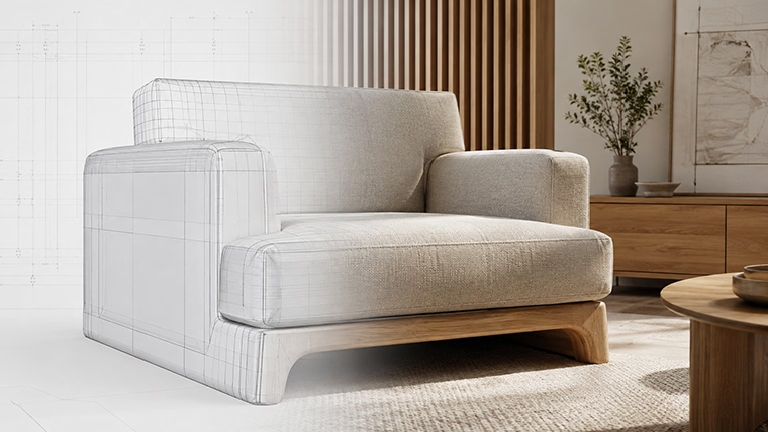
A CAD file is built for engineering precision, dimensions, tolerances and geometry a manufacturer can work from. It is not built for how a sofa, chair or cabinet looks to a buyer. Turning that engineering data into a marketing image is what closes the gap.
CAD rendering services for UK furniture manufacturers turn existing product CAD into marketing-ready imagery for ecommerce, catalogues, retailer presentations and product launches. Instead of relying entirely on physical photography, manufacturers can use accurate 3D visuals to present products, finishes and variations before physical stock is available.
We work with furniture and home manufacturers and design studios across the UK, turning product CAD into marketing-ready imagery for ecommerce, catalogues, retailer presentations and product launches.
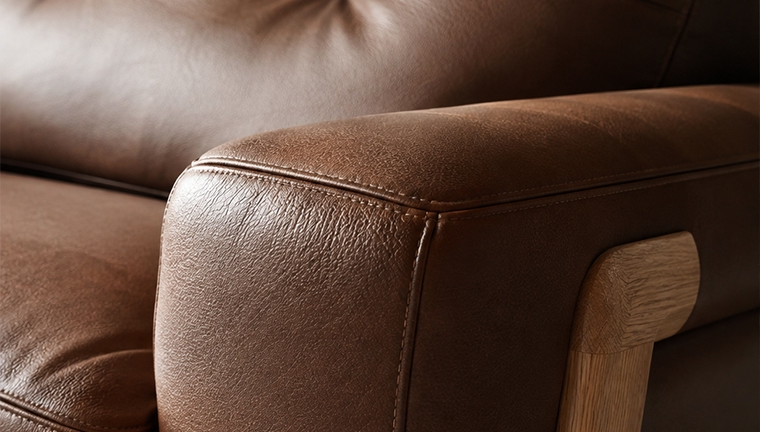
The CAD model has the right dimensions and shape, but no leather grain, finish sheen or sense of how light catches a stitched seam. Those are the details a buyer judges when deciding whether a product looks and feels right.
Material work does much of the heavy lifting. A leather sofa’s CAD file might be geometrically finished, but the render still needs to capture how the leather grain responds to light across a tufted seam or flat panel. Get that wrong and the material can look like plastic, however accurate the model underneath.
That is where hyperrealistic rendering matters. The aim is not simply to make the CAD model look polished, but to create imagery that communicates the material, finish and quality of the actual product closely enough to do the job of a photograph.
For furniture brands, the finished image is the marketing asset. It can be created before physical stock exists, used to launch a range, brief retailers or build ecommerce listings, and updated for new finishes and colourways without reshooting the catalogue.
How a CAD File Becomes a Finished Image
The file is imported, cleaned up, and rebuilt with real-world materials and lighting. 3D CAD rendering services take the existing product geometry and build the materials, lighting and environment needed to turn it into a finished visual. A scene is constructed around it, a plain background for a marketplace listing, a styled room set for a lifestyle spread, and the image is produced at whatever resolution the end use requires. Revisions adjust angle, lighting, or material until it matches the brief.
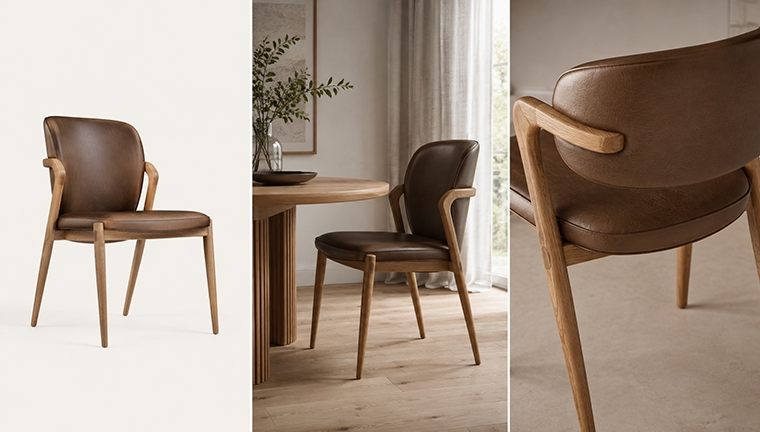
This CAD-to-CGI workflow keeps the original product geometry intact while adding the materials, lighting and environments required for a finished marketing visual.
A dining chair built for a marketplace listing and a lifestyle spread needs two different treatments from one base model, not two separate builds. The same applies to a sofa range across five fabric options, or a cabinet range across three timber finishes.
3D CAD rendering services make this possible by keeping the underlying geometry consistent while adapting materials, environments, camera angles and output formats to different marketing requirements.
CGI can also start before a product physically exists. Photography can’t. For a furniture brand managing multiple finishes or launching ahead of stock, that timing difference can make 3D rendering a more practical production option.

What Drives the Cost of CAD Rendering?
There is no single price for CAD rendering. Cost is set by geometry complexity, the number of finishes or colourways, the number of angles or formats, and how many revision rounds are agreed upfront. One armchair in one fabric is a different job to a five-piece dining set across three finishes, produced for both marketplace and lifestyle formats.
| What Changes the Price | Why |
|---|---|
| Number of finishes/colourways | Each variant is effectively a separate asset to build and light |
| Number of angles or formats | Multiplies output without multiplying the underlying model |
| Revision rounds included | More flexibility built in upfront, less negotiation later |
| Turnaround time | Compressed timelines usually mean additional resourcing |
Why Furniture Manufacturers Use CAD Rendering
Furniture ranges often involve multiple fabrics, colours, finishes, configurations and sizes. Producing photography for every combination can become expensive and difficult to manage, particularly when products are still in development.
Product visualisation for manufacturers can also support product launch visualisation by giving marketing and sales teams finished imagery before physical products are available.
With 3D product visualisation UK services, manufacturers can create visuals for different product configurations without producing every physical variation for a photoshoot.
This can be particularly useful for:
- New product launches before physical stock is available
- Ecommerce listings across multiple colourways
- Furniture catalogues and retailer presentations
- Product configurators and digital sales tools
- Lifestyle imagery for marketing campaigns
- Showing finishes that are difficult or expensive to photograph
- Updating product imagery when a new finish is introduced
- Product launch visualisation before physical stock is available
The underlying CAD model can also provide a consistent starting point for future visual assets. Once the product has been prepared for CGI, additional views, finishes and environments can be developed without rebuilding the product from scratch.
Choosing a CAD Rendering Partner
A CAD rendering partnership that has to hold across multiple ranges depends on more than the lowest quote. The output is judged against a real photograph, that’s the standard it has to meet. Ask a studio for furniture-specific examples at the resolution the image will actually be used at, not a general reel. Ask how they handle a fabric or finish that comes back looking flat on the first pass. A studio that treats that as routine, not as a complaint, is the more reliable choice over time.
For a design studio, it is also worth asking how the rendering team works within an existing production workflow and handles ongoing batches of work. The right partner should be able to follow your creative direction, visual standards and approval process without adding unnecessary steps.
If you are considering outsourced CAD rendering services UK providers, the briefing process is equally important. Sharing the CAD file, product references, required finishes and a rough sense of how many formats are needed allows the studio to establish a realistic scope and cost estimate.
For teams with regular product launches or large furniture ranges, outsourcing can also provide additional production capacity without requiring an in-house CGI team.
Frequently Asked Questions
1) Do you work with studios on a long-term basis?
Answer: Yes. We work with studios and manufacturers globally, including clients who work with us on regular retainers.
2) What does working with you look like?
Answer: We fit into your existing workflow and handle the rendering production while your team stays in control of the creative direction and client relationship.
3) What makes your renders different from standard CGI?
Answer: We focus on hyperrealistic imagery, with close attention to materials, textures, lighting and finishes so the final image feels like a real product photograph.
4) What do you need from us to get started?
Answer: Usually, the CAD file, product references and details of the required imagery. We can work with your existing specifications and visual references.
5) How do you handle large furniture ranges?
Answer: We build a consistent base workflow, then apply it across products, finishes, colourways and views. This keeps the imagery consistent as the range grows.
6) What if we already have a visual style or CGI standard?
Answer: We follow it. Existing renders, photography, brand guidelines and material references can all be used to establish the required look.
7) How can I get a CAD rendering quote?
Answer: Share your CAD files, product references and the approximate number of products, finishes, views and formats required. Request a CAD rendering quote to discuss the scope and production requirements.