

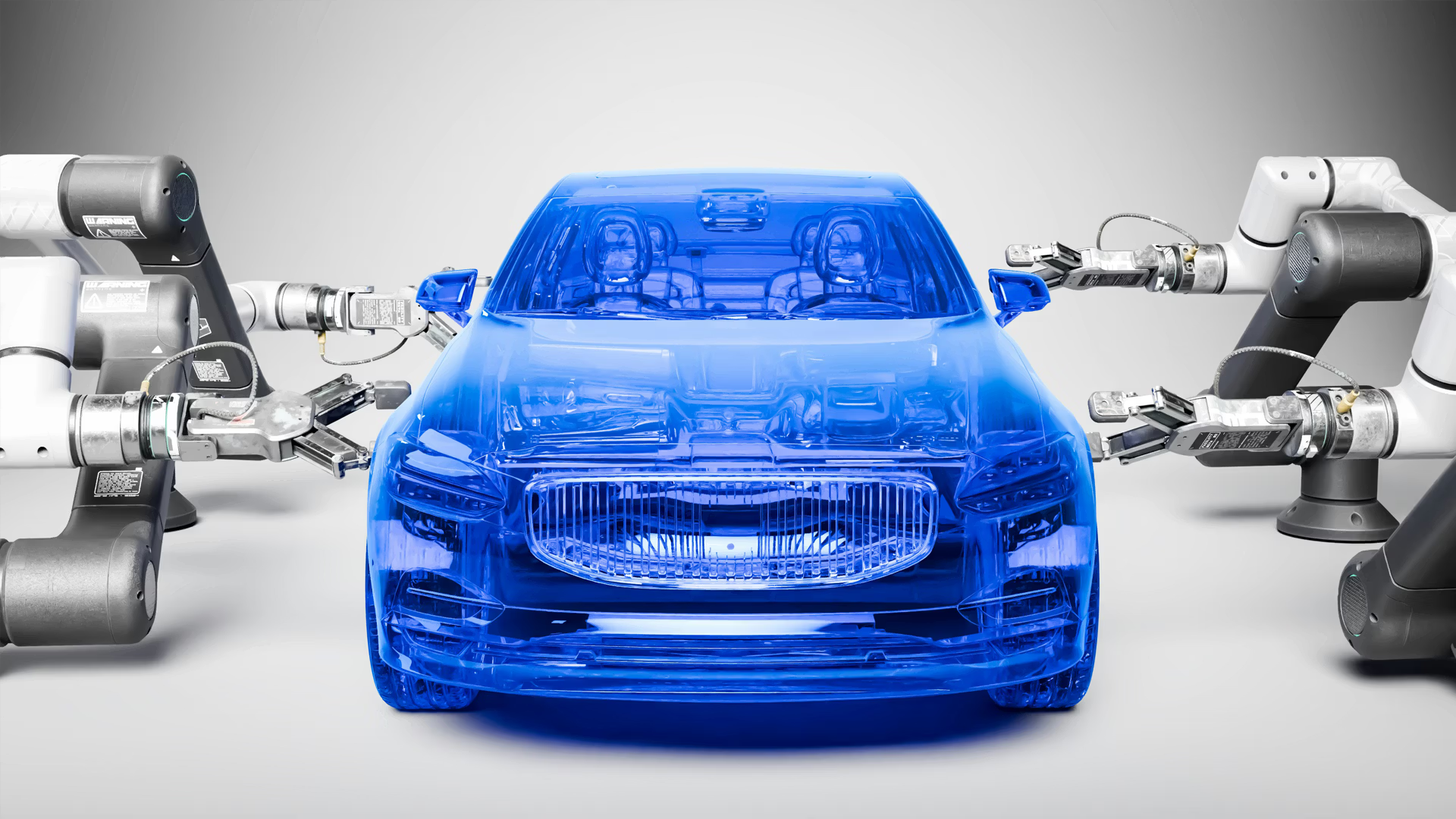
In today’s high-stakes Automotive Advertising landscape, attention is engineered—not captured. At Night Wolves Studio, we see Automotive VFX and CGI in Car Commercials not as post-production enhancements, but as the core architecture of modern storytelling. What was once constrained by physics, logistics, and timing is now driven by precision-built digital worlds.
This is the shift: from documenting cars… to designing desire.
The Rise of VFX in Automotive Advertising
CGI in Car Commercials has become foundational to Automotive Marketing, not optional. The reason is simple—control, scalability, and imagination.
Why leading automotive brands are going VFX-first:
1. Creative Without Constraints
Cars are no longer bound to real-world terrain. With Automotive VFX, vehicles can exist in hyper-real environments, impossible landscapes, and narrative-driven universes that amplify brand identity.
2. Precision-Level Control
Every reflection, surface highlight, camera move, and environmental variable is engineered. This level of control is unattainable in traditional production.
3. Pre-Production Marketing Power
With CGI in Car Commercials, campaigns begin before the car physically exists. This enables global launches, teasers, and configurator-ready visuals months in advance.
4. Scalable Global Content
Single master assets can be adapted across markets—left-hand drive, right-hand drive, terrain shifts, lighting variations—without re-shooting.
Case Studies: VFX in Action
1. The Blackbird System — A Turning Point in Automotive VFX
The Blackbird rig redefined production pipelines in Automotive Advertising. It captures real-world motion while allowing complete digital replacement of the vehicle using CGI.
What it enabled:
- Shooting without a final car model
- Maintaining real physics with digital flexibility
- Accelerating campaign timelines dramatically
Impact on Automotive Marketing:
Brands can now execute full-scale campaigns without waiting for manufacturing readiness—compressing go-to-market cycles.
2. Audi “Duel” — Storytelling at Cinematic Scale
This campaign demonstrates how CGI in Car Commercials elevates narrative complexity.
VFX breakdown:
- Seamless integration of CGI vehicles with live-action stunts
- Digital city extensions to intensify scale
- High-precision compositing for continuity and realism
What it proves:
In Automotive Advertising, spectacle isn’t excess—it’s strategy. VFX enables storytelling that holds attention in a saturated media environment.
3. Mercedes-Benz “Chicken” — Metaphor Meets Engineering
A masterclass in concept-driven Automotive VFX.
Execution:
- Photoreal CGI chickens with nuanced motion dynamics
- Subtle compositing blending live-action and CG elements
- Physics-driven animation to mirror suspension stability
Strategic takeaway:
Great Automotive Marketing doesn’t just show features—it translates them into memorable, emotional metaphors.
How VFX is Reshaping Automotive Marketing
1. Product Visualization at Photoreal Scale
With advanced VFX Studio pipelines, vehicles can be rendered with near-perfect material accuracy—paint, glass, chrome, interiors—down to microscopic detail.
2. Narrative Engineering
CGI in Car Commercials allows brands to design stories that would otherwise be impossible—turning functional specs into cinematic experiences.
3. Speed to Market
Campaigns are no longer dependent on physical production timelines. This gives automotive brands a competitive edge in launch velocity.
4. Multi-Platform Ecosystems
From TVCs to Instagram reels to immersive web experiences—Automotive VFX assets are built once and deployed everywhere.
Future of Automotive VFX
The next evolution of Automotive Advertising is already in motion:
- Real-Time Rendering Pipelines: Game-engine-based workflows (like Unreal) are enabling live visualization, instant iteration, and interactive experiences.
- AI-Driven Automotive Marketing: Dynamic content generation tailored to user behavior—location, preferences, and engagement patterns.
- AR & VR Integration: From virtual showrooms to immersive test drives, CGI in Car Commercials is expanding into experiential platforms.
- Sustainable Production Models: Eliminating physical shoots reduces logistics, travel, and environmental impact—making Automotive VFX a strategic sustainability lever.
Night Wolves Studio Perspective
At Night Wolves Studio, we don’t “add VFX” to commercials.
We build automotive experiences from the ground up—where CGI, storytelling, and brand strategy operate as one system.
If you explore our Work, you’ll see how high-performance visuals translate into high-impact campaigns.
Curious about how we approach complex automotive narratives?
Our Experience breaks it down.
Conclusion
The transformation of Automotive Advertising is not coming—it’s already here.
CGI in Car Commercials and Automotive VFX are now the backbone of how modern automotive brands communicate, launch, and scale.
The brands that win are not the ones who adopt VFX.
They’re the ones who think in VFX from day one.
If you’re building the next generation of automotive campaigns,
connect with a VFX Studio that understands both engineering and emotion:
https://nightwolves.studio/contact
People Also Ask
1. How is VFX used in automotive commercials?
Ans: Automotive VFX is used to create photorealistic vehicles, simulate dynamic environments, and execute complex cinematic storytelling. It enables brands to visualize cars before production and deliver high-impact narratives.
2. What are the benefits of CGI in Car Commercials?
Ans: CGI in Car Commercials provides total creative control, scalability, faster campaign execution, and the ability to produce global-ready content from a single asset pipeline.
3. Can VFX replace real car footage in commercials?
Ans: Yes. With advanced pipelines and tools like digital doubles and rig-based capture systems, entire vehicles can be created or replaced using CGI—often indistinguishable from reality.
4. How does VFX improve Automotive Marketing storytelling?
Ans: It transforms technical features into cinematic narratives—making campaigns more engaging, memorable, and emotionally resonant.
5. What is the future of Automotive VFX?
Ans: Real-time rendering, AI-driven personalization, immersive AR/VR experiences, and sustainable production workflows will define the next phase of Automotive Advertising.